
ORBISCAN — BLOG PAGE CONTENT

Hero Section

Security Screening & X-Ray Inspection Insights

Explore practical information about X-ray baggage scanners, security screening technology, baggage inspection, X-ray image performance, and inspection systems.

Read our latest articles to understand how X-ray inspection technology supports security operations across airports, offices, mail screening facilities, and other controlled environments.

Button: Explore Articles

Secondary Button: View Products


Latest Insights

Explore Our Latest Security Screening Articles

Stay informed with technical guides, product information, and practical insights related to X-ray inspection and security screening systems.


Featured Article

How X-Ray Baggage Scanners Work

X-ray baggage scanners allow security personnel to inspect bags, packages, and other items without opening them manually. By producing internal images of scanned objects, these systems help operators examine contents and identify items that may require further inspection.

Modern X-ray inspection systems can be used in environments such as airports, offices, mail screening areas, and high-security facilities.

Button: Read Full Article →


Blog Categories

Browse by Topic

X-Ray Inspection
Learn about X-ray scanning technology, inspection processes, and system performance.

Security Screening
Understand the role of inspection equipment in modern security screening environments.

Baggage Inspection
Explore baggage screening applications for airports, offices, and controlled facilities.

Inspection Technology
Learn about image quality, penetration performance, detection technologies, and system operation.

Product Insights
Explore technical information about Orbiscan inspection systems.


Blog Articles

01 — X-Ray Inspection

What Is an X-Ray Baggage Scanner and How Does It Work?

An X-ray baggage scanner is designed to generate internal images of luggage, packages, and other objects during security inspection. The technology allows operators to examine the contents of an item without physically opening it.

Understanding the basic scanning process can help organizations evaluate the right inspection equipment for their security requirements.

Button: Read Article →


02 — Security Screening

How to Choose an X-Ray Baggage Scanner

Selecting an X-ray baggage scanner requires consideration of several technical and operational factors. These can include tunnel size, X-ray generator performance, penetration capability, image quality, detector technology, operating environment, and workflow requirements.

The appropriate system should be selected according to the type of objects being inspected and the requirements of the facility.

Button: Read Article →


03 — Inspection Technology

Understanding X-Ray Image Performance in Security Screening

Image performance is an important part of X-ray inspection. Clear imaging can help operators examine the contents of baggage and packages more effectively.

Factors such as image resolution, image enhancement functions, penetration capability, zoom functions, and display performance can influence the inspection process.

Button: Read Article →


04 — Product Insights

Orbiscan Ai-6550 X-Ray Baggage Scanner

The Orbiscan Ai-6550 is an X-ray baggage scanning system designed for security inspection applications.

Its listed specifications include a 650 × 500 mm tunnel, 140 kV X-ray tube, and steel penetration performance of up to 30 mm. The system also includes image-processing functions and features intended for security screening environments.

The Ai-6550 can be considered for applications including VIP and high-risk security, mail scanning, executive offices, and private security facilities.

Button: View Ai-6550 →


05 — Product Insights

Orbiscan Si-4884 X-Ray Inspection System

The Orbiscan Si-4884 is an X-ray inspection system designed for applications requiring detailed examination of baggage and other objects.

The system incorporates X-ray imaging and image-processing functions to support security inspection workflows. Its application areas can include security screening environments where operators need to examine the contents of bags and packages.

Button: View Si-4884 →


06 — Security Solutions

X-Ray Baggage Screening for Airports and Security Facilities

Security screening requires inspection processes that are suitable for the environment, expected traffic, and types of items being examined.

X-ray baggage inspection systems can support screening operations by allowing personnel to examine the internal contents of baggage and packages before deciding whether additional inspection is required.

Button: Read Article →


07 — Technical Guide

Why X-Ray Penetration Matters in Baggage Inspection

Penetration performance is an important specification when evaluating an X-ray inspection system. It relates to the system’s ability to produce useful inspection images through dense materials.

For facilities handling different types of baggage and packages, penetration capability should be considered alongside image quality, tunnel dimensions, detector technology, and operating requirements.

Button: Read Article →


08 — Security Screening

X-Ray Inspection vs. Manual Baggage Inspection

Manual inspection and X-ray inspection use different approaches to examining baggage. Manual inspection requires physical access to the contents, while X-ray inspection allows operators to examine an internal image before deciding whether further physical inspection is necessary.

In many security environments, X-ray inspection can form part of a broader screening workflow.

Button: Read Article →


Security Screening Knowledge Center

Learn More About X-Ray Inspection Technology

Our Security Screening Knowledge Center provides practical information about X-ray baggage scanners, inspection systems, image performance, penetration capability, and security screening applications.

Whether you are researching X-ray inspection technology or evaluating equipment for a specific facility, our articles provide technical information to help you understand the main considerations involved.

Explore Topics:

  • X-Ray Baggage Scanners
  • X-Ray Inspection Systems
  • Security Screening Equipment
  • Baggage Inspection
  • X-Ray Image Performance
  • X-Ray Penetration
  • Security Inspection Technology
  • Airport Security Screening

Our X-Ray Inspection Systems

Explore Orbiscan Products

Orbiscan provides X-ray inspection equipment for security screening and baggage inspection applications.

Orbiscan Ai-6550

X-Ray Baggage Scanner

A professional X-ray baggage inspection system designed for security screening applications, with a 650 × 500 mm tunnel and high-penetration X-ray inspection capability.

Button: View Product →


Orbiscan Si-4884

X-Ray Inspection System

An X-ray inspection solution designed to support security screening and detailed inspection of baggage and other objects.

Button: View Product →


CTA Section

Need Information About X-Ray Inspection Systems?

Looking for technical information about Orbiscan X-ray inspection equipment?

Contact our team to discuss product specifications, applications, and security screening requirements.

Button: Contact Us →

Secondary: View Products →


Newsletter / Updates Section

Stay Informed About Security Screening Technology

Receive the latest Orbiscan articles and technical information covering X-ray inspection, baggage screening, and security inspection technology.

Email Placeholder:
Enter your email address

Button: Subscribe


Footer Content

ORBISCAN

Professional X-ray inspection and security screening solutions.

Products

  • Ai-6550 X-Ray Baggage Scanner
  • Si-4884 X-Ray Inspection System

Resources

  • Blog
  • X-Ray Inspection
  • Security Screening
  • Product Information

Company

  • About Us
  • Contact Us

Website:
www.orbiscan.us

© 2026 Orbiscan. All Rights Reserved.


SEO Meta Content

Meta Title

X-Ray Inspection & Security Screening Blog | Orbiscan

Meta Description

Explore Orbiscan insights on X-ray baggage scanners, security screening, baggage inspection, X-ray image performance, and inspection technology.

Suggested Blog URL

/blog/

Main H1

Security Screening & X-Ray Inspection Insights

Primary SEO Keywords

  • X-ray baggage scanner
  • X-ray inspection system
  • security screening equipment
  • baggage inspection system
  • X-ray security scanner
  • baggage screening equipment
  • X-ray inspection technology
  • airport security scanner
  • security inspection system
  • X-ray baggage inspection

Internal Linking Structure

Use internal links between the blog and the two product pages:

Blog → Ai-6550 Product Page
Blog → Si-4884 Product Page
Ai-6550 → Related Blog Articles
Si-4884 → Related Blog Articles
Blog Articles → Contact Us

This gives the page a proper SEO content-hub structure instead of making it look like a simple news/blog listing.

Road to Eye-Catching Landscape

Road to Eye-Catching Landscape

Road to Eye-Catching Landscape

A beautiful landscape is more than a collection of colors, buildings, trees, and open spaces. It is a visual experience that creates a feeling, communicates an idea, and captures attention.

Whether you are designing a landscape photograph, travel banner, social media post, website hero section, or promotional artwork, the right combination of composition, color, lighting, and detail can transform an ordinary scene into an eye-catching landscape.

What Makes a Landscape Eye-Catching?

An effective landscape design usually has one clear visual focus. The viewer should immediately understand where to look and what makes the scene interesting.

Strong landscapes often combine several important elements:

  • Balanced composition
  • Attractive color combinations
  • Natural or dramatic lighting
  • Strong foreground and background
  • Clear visual hierarchy
  • Interesting textures and details
  • Appropriate use of negative space

The goal is not to add everything into one design. The goal is to make every element serve a purpose.

1. Start With a Strong Composition

Composition is the foundation of an eye-catching landscape. Before adding effects, text, or decorative elements, decide how the main subjects will be arranged.

The rule of thirds is one useful approach. Imagine your image divided into nine equal sections using two horizontal and two vertical lines. Positioning important elements near these lines can create a more balanced composition.

Leading lines can also guide the viewer’s eyes through the scene. Roads, rivers, buildings, bridges, fences, and pathways can naturally direct attention toward the main subject.

2. Use Color With Purpose

Color can completely change the mood of a landscape.

Warm colors such as yellow, orange, and red can create feelings of energy, warmth, and excitement. Cool colors such as blue and green can create a calmer and more natural atmosphere.

A good landscape does not necessarily need many colors. A controlled palette can often produce a cleaner and more professional result.

For graphic design projects, choose colors that also support the brand or message. This becomes especially important when the landscape is being used as a marketing background.

3. Make Lighting Work for You

Lighting is one of the strongest tools for creating visual impact.

Early morning and late afternoon light can create soft shadows and warm highlights. Strong directional light can add depth and make architectural or natural elements more dramatic.

When editing a landscape, avoid making the lighting look unnatural. Adjust brightness, contrast, highlights, and shadows carefully so that the final image still feels believable.

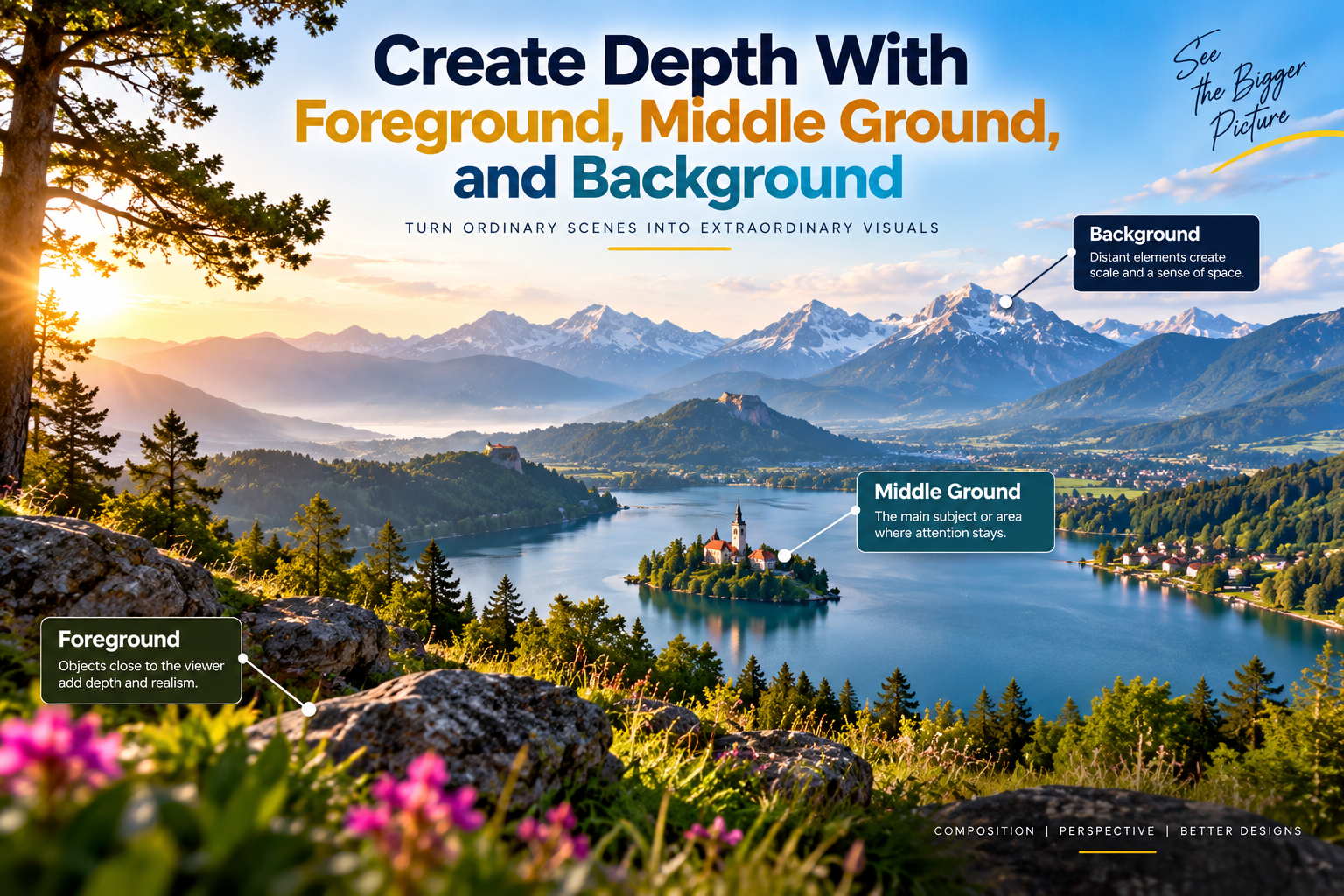
4. Create Depth With Foreground, Middle Ground, and Background

Create Depth With Foreground, Middle Ground, and Background

Flat images can sometimes feel less engaging because everything appears to exist on the same visual plane.

A simple way to create depth is to divide the landscape into three layers:

Foreground:
Objects close to the viewer, such as plants, roads, rocks, vehicles, or architectural details.

Middle Ground:
The main subject or area where the viewer’s attention should remain.

Background:
Mountains, buildings, sky, distant roads, or other environmental elements.

Combining these layers gives the viewer a stronger sense of space.

5. Keep the Main Subject Clear

One common mistake is making every part of a landscape equally important.

Instead, choose one primary subject. It could be a building, mountain, road, person, vehicle, product, or city skyline.

Use contrast, lighting, scale, positioning, or color to make that subject stand out.

If text is being added to the landscape, leave enough negative space around the text so it remains readable without covering important visual elements.

6. Use Negative Space

Negative space is the empty or less detailed area surrounding the main subject.

The sky is often an excellent example of negative space in landscape design. A clean sky can provide enough room for a headline, logo, or promotional message.

Instead of filling every area with graphics, allow the composition to breathe. This can make the design look cleaner and more premium.

7. Add Details Without Creating Clutter

Small details can make a landscape more interesting. Textures, shadows, reflections, clouds, vegetation, architectural features, and atmospheric elements can add realism.

However, too many details can make the design confusing.

A useful principle is simple:

Add details that support the story. Remove details that distract from it.

8. Consider the Final Platform

An eye-catching landscape should be designed according to where it will be used.

For example:

  • Instagram: Square or vertical compositions work well.
  • Website hero: Wide landscape compositions are usually more suitable.
  • YouTube thumbnail: Strong subject placement and readable text are important.
  • Print brochure: Higher resolution and proper print dimensions are required.
  • Social media advertisement: The main message should remain visible even on smaller screens.

The same landscape may need different crops for different platforms.

9. Use Typography Carefully

When a landscape is used as a promotional graphic, typography becomes part of the visual composition.

Choose fonts that match the subject and maintain strong contrast between the text and background.

A simple hierarchy can include:

Main Headline
Large and attention-grabbing.

Supporting Text
Smaller information that explains the message.

Call to Action
A short instruction such as “Explore Now,” “Discover More,” or “Get Started.”

Avoid using too many font styles in one design. Consistency makes the final composition easier to understand.

10. Balance Creativity With Simplicity

Balance Creativity With Simplicity

An eye-catching landscape does not need excessive effects.

Gradients, glows, overlays, shadows, filters, and other effects should be used carefully. When every element is highly edited, the design can lose its natural character.

Strong design usually comes from making deliberate choices rather than adding more elements.

The Road to a Better Landscape Design

Creating an attractive landscape is a process. Start with the composition, establish the focal point, build depth, control the colors, refine the lighting, and then add supporting details.

Before finishing, step away from the design and look at it again. Ask yourself:

  • What do I notice first?
  • Is the main subject clear?
  • Is the text easy to read?
  • Do the colors work together?
  • Does the image have enough depth?
  • Is anything distracting from the main message?

These simple questions can help identify problems before the final design is published.

Final Thoughts

The road to an eye-catching landscape begins with a strong visual idea and ends with careful execution. Composition, lighting, color, depth, typography, and negative space all work together to create a memorable visual.

Whether you are creating a landscape photograph or a professional marketing graphic, focus on clarity first. Once the foundation is strong, creative details can take the design to the next level.

Great landscape design is not about adding more. It is about making every visual element matter.

ChatGPT Image Sep 15, 2026, 04_34_23 PM

Road to Eye-catching landscape


The new common language will be more simple and regular than the existing European languages. It will be as simple as Occidental; in fact, it will be Occidental. To an English person, it will seem like simplified English, as a skeptical Cambridge friend of mine told me what Occidental is. The European languages are members of the same family.

  • Get yourself comfortable.
  • Manage your workspace and organize your desk.
  • Adjust the work/life balance.
  • Keep in touch with your co-workers.

Architecture is inhabited sculpture

Lorem ipsum dolor sit amet, consectetur adipiscing elit. Praesent ullamcorper ex nunc, in fringilla orci fringilla sed. Nam semper odio eu urna viverra, eu luctus mauris sollicitudin. Morbi ultricies est et odio vehicula, vel lacinia ipsum ullamcorper. Mauris mattis placerat quam, aliquam vestibulum dui bibendum eu. Curabitur eu euismod ex, et hendrerit purus. Donec condimentum vel neque id iaculis. Etiam dui id dolor lobortis cursus ac maximus nisl. In sodales lacus nec cursus varius.

A room is not a room without natural light

Morbi ultricies est et odio vehicula, vel lacinia ipsum ullamcorper. Mauris mattis placerat quam, aliquam vestibulum dui bibendum eu. Curabitur eu euismod ex, et hendrerit purus. Donec condimentum vel neque id iaculis. Etiam dui id dolor lobortis cursus ac maximus nisl. In sodales lacus nec cursus varius.